
(Scholarly, Bigger Picture): Shore, Rebecca. Developing Young Minds: From Conception to Kindergarten. Maryland, London: Rowman & Littlefield, 2015. Print.
This book is about the early developmental stages of babies’ brains and how their memory and learning techniques grow in their home environment. Although babies don’t study, they have the largest potential to expand their minds—and quickly. By “potential,” I mean that babies have the greatest amount of neurons available to create learning links and to collect new information through things called dendrites. Dendrites are branch-like expansions of the neuron. Exposing children to increasingly complex images and words, starting as young as a few months old, will quickly expand their dendrites which hold information. It also creates a foundation of learning which encourages children to pursue their curious endeavours during adolescence. The book also ties in what kind of families these babies grow up in and what the family’s socioeconomic status is.
(Scholarly, Bigger Picture): Kraly, F. Scott. Brain Science and Psychological Disorders: Therapy, Psychotropic Drugs, and the Brain. New York, N.Y.: W. W. Norton & Company, Inc., 2006. Print.
The book is a very scientific approach to the study of the brain. It focuses largely on disorders such as ADHD, PTSD, eating disorders and the drugs that cure them by changing the signals to the brain. There’s not much in it for education, but it does talk about how the neurological receptors are changed to be able to receive and input information differently while using psychoactive drugs to alter hormones, mood, and behaviour. This could be bigger picture by explaining how our brains are often susceptible to change through small doses of medication and that this could have a greater impact on humanity as we adapt students to conform to the western education system.
(Blog, Bigger Picture): Helping Students Memorize: Tips from Cognitive Science
This source talks about memory function in the classroom, written by a psychological science professor. Not all subjects require extensive memorization, but for a course such as human anatomy, it definitely “challenge students’ capacity to retain dozens of new terms and concepts.” I learned about a phonological loop which precisely the thing that occurs when repeating a new phone number over and over before finding a place to write it down. It’s the brief memorization of new auditory information. It’s important to mention this because the brain has developed strategies to cope with high levels of memorization in humans. This is bigger picture because it is touching on the subject of memorization required for long-term learning and career paths, plus it’s interesting that humans are the only animals on the planet that require extensive memory (among other things) to find success and growth in life.
(Blog, Bigger Picture): Is Technology Good or Bad for Learning? https://www.brookings.edu/blog/brown-center-chalkboard/2019/05/08/is-technology-good-or-bad-for-learning/
This article is very summative and to-the-point about the good and bad about learning with technology. On the one hand, technology “drive[s] equity in learning opportunities.” Instructional practices have improved with technology in catering to students with higher special needs. The article also mentions (and is a good link to source 1) the opportunities for public learning of students from all ethnic backgrounds, socioeconomic status, etc. There is still the association (not cause) of negative neurological impact due to increased technology. This would include ADHD and social anxiety. It ends off by stating that while there may be potential benefits to technology, we must always remain mindful of the potential risks that are underlying. This is bigger picture because it talks about the people who could benefit and the long run of our technological advancements.
(Article, Bigger Picture): https://www.gse.harvard.edu/news/14/11/benefit-interactive-learning
This article was about a physics professor at the Harvard school of Engineering and Applied sciences. He explains that his teaching methods for the longest time were just a “transfer of information.” Then the interesting part was that he realized that once he started making students interact with each other more and more with engaging topics of conversation, the students were all awake and paying attention to him. He talks, almost inspiringly, about bringing the “ownership of learning” that is found in early elementary school back into higher education. This is first hand information from a person in the teaching field who has discovered a key element to keeping students engaged in class. The bigger picture is that higher education doesn’t only need to be about lectures and huge classrooms full of boredom and cramped studying.
(Photo, Bigger picture)
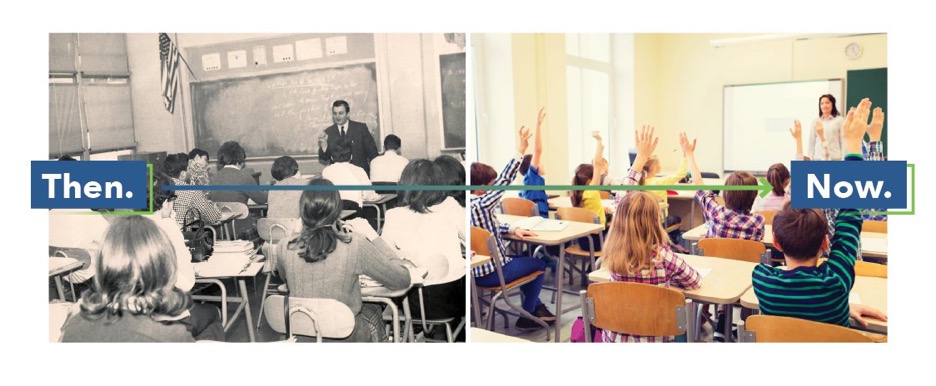
This is a photo of a classroom from around 1960 to a classroom now. Notice that there isn’t much difference. It struck me when I saw this photo that there has really not been much change in the school system in a while. Could this be a cause for concern for students? Have we evolved at all in the field of education? We have a few relatively new interactive learning classrooms and iPads/laptops. As source 7 suggest, changing the learning environment with technology could increase individualized and specialized education strategies.
 Faith’s Blog